
By James Benedetto, ISA Certified Arborist OH-7011A
Drive through almost any Central Ohio neighborhood in spring and you will see mulch volcanoes: cones of fresh, dark mulch piled high against tree trunks. They look tidy, and they are usually built with good intentions. They are also one of the most common tree care mistakes we see.
The practical answer: A mulch volcano is mulch mounded against a tree trunk instead of spread across the root zone. It keeps trunk bark wet, can encourage stem-girdling roots, and hides the root flare where early problems are easiest to spot. The right approach is a wide, flat mulch ring, about 2 to 3 inches deep for typical shredded hardwood, with the mulch pulled back from the trunk and the root flare visible.
What Is a Mulch Volcano?
The root flare, sometimes called the trunk flare, is the point where the trunk widens and transitions into the main roots. On a healthy tree, it should be visible above the soil line. If the trunk disappears straight into the mulch like a telephone pole, the root flare is buried.
Most mulch volcanoes are not built in one day. Each spring, a fresh layer goes on top of the last. Nobody checks the existing depth, the lower layers decompose into material that looks like soil, and the pile slowly creeps higher up the trunk.
Why Do Mulch Volcanoes Damage Trees?
Bark is not root tissue. Trunk bark is built to shed water and dry out. When it stays buried against damp mulch, it can soften, crack, and decay. That gives decay organisms an opening they would not otherwise have.
They can encourage stem-girdling roots. Roots take advantage of the moisture and oxygen in decomposing mulch. As they grow into the mound, they can turn back toward the trunk instead of spreading into the surrounding soil. Over time, those roots thicken, press against the stem, and restrict the tree’s vascular system.
They hide the base of the tree. Some of the most important things we inspect on a mature tree are at the root flare. Buried under mulch, early decay, damaged bark, and girdling roots can go unnoticed until symptoms begin showing in the canopy.
They give rodents cover. Voles and mice chew bark during the winter, and a deep mulch pile gives them protected access to the trunk.
Why Does the Damage Take Years to Appear?
A mulch volcano does not kill a tree quickly. That is exactly why the practice persists. Nothing obvious happens the first summer, so another layer goes on the following spring.
Meanwhile, the problems develop underneath the mulch while the canopy may still look normal. By the time the crown starts thinning or losing color, the root and trunk damage may already be well established.
How Do You Remove Mulch Volcanoes Safely?
Start by pulling the mulch back by hand until you find the root flare. On an older mound, the upper layers may still look like mulch while the lower layers have broken down into something that looks more like soil. Do not assume that the current grade is the original grade.
Go slowly. Buried bark may already be soft, and fine roots may be growing through the mound. A shovel can turn a mulch problem into a root or trunk injury.
Once the flare is exposed, look for roots crossing or wrapping the trunk, compressed bark, cavities, or soft tissue. Some small girdling roots can be removed, but size, position, tree species, and overall condition all matter. Large roots, or roots that have fused against the trunk, should be assessed before anything is cut.
When the buildup is deep or the root collar is congested, we use compressed air to expose the structural roots while minimizing damage. Learn more about our air-spade root care and soil health.
How Should You Mulch Around a Tree?
Mulch is good for trees when it is applied correctly. It moderates soil temperature, holds moisture, reduces competition from turf, and protects the trunk from mowers and string trimmers.
For typical shredded hardwood mulch, keep the total depth around 2 to 3 inches. Check what is already there before adding more. Most trees do not need another full layer every spring. If the existing mulch still has enough depth, rake it lightly instead of burying it under another load.
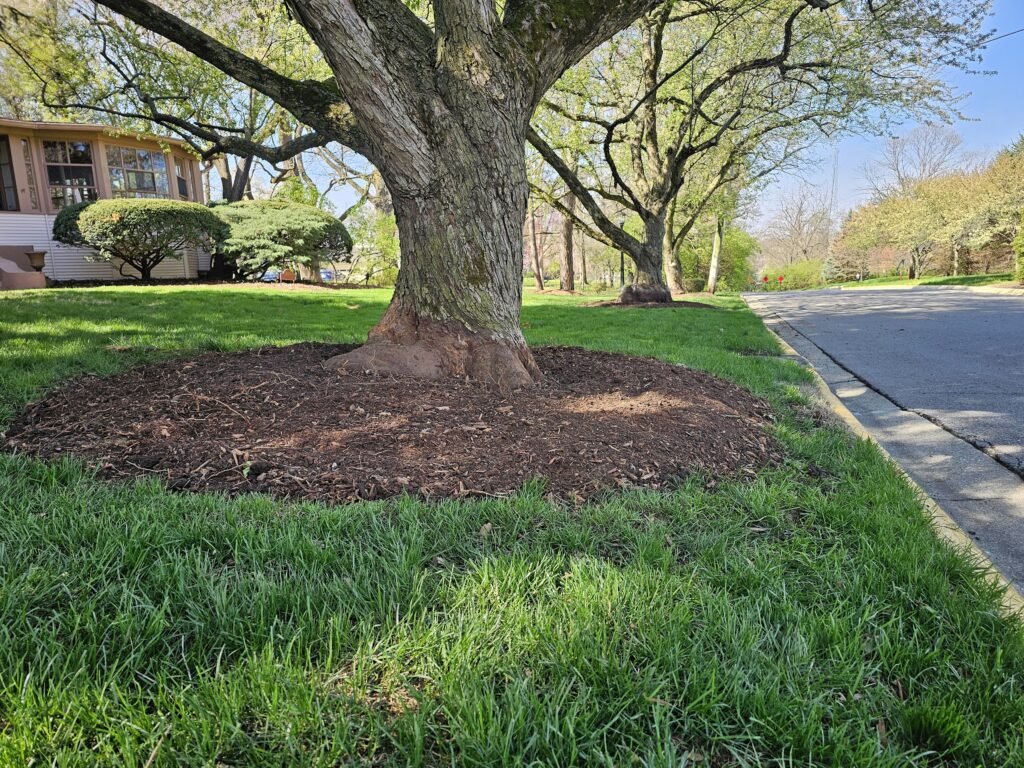
Pull the mulch back 3 to 6 inches from the trunk so the root flare stays visible and dry. Spread the ring as wide as practical, ideally toward the drip line or beyond. A broad, flat ring protects more of the root zone without burying the trunk.
Wide and flat. Not tall and cone-shaped.
Ohio State University Extension has a useful explanation of why mulch volcanoes damage trees and how to mulch correctly.
When Should an Arborist Inspect It?
Not every mulch volcano requires professional excavation. A shallow, recent buildup with intact bark may need only correction and monitoring. A long-standing pile with damaged bark, a deeply buried root flare, established girdling roots, or canopy decline deserves a closer look.
If years of mulch have built up around a tree in Columbus or Central Ohio, request a consultation. We can expose enough of the base to see what is happening and recommend the least invasive correction that makes sense.
Emerald Ash Borer in Central Ohio: Signs, Treatments, and How to Save Your Tree
If you have an ash tree in Central Ohio whether you’re in Columbus, New Albany, or the surrounding suburbs the emerald ash borer (EAB) is probably the single biggest threat it faces. This invasive beetle has killed the vast majority of untreated ash trees across Ohio over the past two decades, and it doesn’t slow down once it finds a host tree. The good news is that EAB is highly treatable if you catch it early, and knowing what to look for is the first step.
What is the Emerald Ash Borer?
The emerald ash borer is a small, metallic green beetle whose larvae tunnel under the bark of ash trees, cutting off the tree’s ability to move water and nutrients. By the time damage is visible from the ground, the infestation is often already well established. Nearly every ash tree in Ohio that isn’t treated will eventually be affected.
Signs Your Ash Tree May Have EAB
-
Canopy thinning or dieback: Usually starting at the top of the tree and working its way down.
-
D-shaped exit holes: Small holes in the bark about the size of a grain of rice.
-
Splitting bark: Revealing S-shaped tunnels (galleries) underneath the surface.
-
Increased woodpecker activity: Woodpeckers heavily forage on the bark to feed on the larvae underneath.
-
Epicormic sprouting: New, leafy shoots rapidly growing from the lower trunk or base as the tree tries to compensate for canopy loss.
Any one of these signs on its own isn’t a guaranteed diagnosis. However, a combination of two or more-especially a thinning canopy paired with exit holes-is a strong signal that it’s time for a professional tree assessment.
Why Early Identification Matters
Ash trees can decline surprisingly fast once EAB takes hold, sometimes within two to three years from the first symptoms to complete tree death. A tree caught early, while the canopy is still mostly intact, has a much better chance of responding well to treatment. A tree that has already lost more than half of its canopy is a much harder case, and in some situations, professional tree removal becomes the safer and more practical option.
What to Do If You Suspect EAB
The tunneling and canopy loss caused by EAB also severely weaken a tree’s structural integrity. This becomes a real safety concern for any tree growing near a house, driveway, or anywhere people walk and park. If you’re seeing any of the signs above, the right move is to have an ISA Certified Arborist take a look before deciding between saving the tree or safely removing it.
Can My Ash Tree Be Saved?
The short answer is yes-most trees are savable if they have more than 50% of their crown intact.
Here in Central Ohio, EAB populations tend to ebb and flow as new forested ash saplings grow, become infected, and then die. Because we are no longer in the initial, devastating wave of the borer, the pest pressure is typically not high enough to instantly decimate an isolated ash tree. Emamectin benzoate is the best EAB treatment option available and has a 20-year track record of successfully controlling the borer.
What to Expect After Tree Treatment
There are a few very important things to keep in mind once you begin an EAB treatment program. First, the treatment is designed to kill the borer upon ingestion; it does not put a barrier over your tree that repels the insect from landing. Because of this, borers can still cause minor damage before the treatment stops them, meaning you might occasionally see new, small dead branches pop up even on a tree that has been treated for years.
You may also continue to see larger dead branches form after treatment has started. There are two reasons for this:
-
Lagging Damage: The borer’s internal damage hasn’t completely revealed itself yet. It typically takes two to three years after treatment begins to stop losing larger limbs, though this is solely dependent on the condition of the tree prior to treatment.
-
Unrelated Stress: Ash trees can decline for other reasons. While the biggest issue with ash trees is the borer, your tree can still experience drought stress, root problems, and the typical aging associated with any mature tree.
At Arborist Solutions, we offer expert emerald ash borer treatment and diagnosis throughout the Columbus area. Every recommendation starts with an honest assessment of whether a tree is a good candidate for treatment or if removal is the safer route. If you’re noticing thinning, exit holes, or unusual woodpecker activity on an ash tree, reach out for a consultation, and we’ll help you figure out the right next step.
One of the most common questions we get from Central Ohio homeowners is simple: how often should a tree actually be pruned?
The honest answer is that it depends on the tree, not the calendar. At Arborist Solutions, our primary goal is preservation—giving every tree the best chance to safely thrive for a century or longer. To achieve that, we follow the science. According to the International Society of Arboriculture (ISA), pruning should always be driven by specific structural or safety objectives, not a generic timeline.
While age, species, and site conditions dictate the exact schedule, most trees fall into a few general categories that serve as a solid baseline before you call an arborist.
Young Trees: Every 2–3 Years
Newly planted and young trees benefit immensely from regular structural pruning. Extensive research from the University of Florida’s Environmental Horticulture program–a leading authority on urban tree canopy—demonstrates that early structural pruning to establish a strong central leader and well-spaced scaffold branches is the single best way to prevent catastrophic failures decades later. Skipping this stage guarantees weak branch unions and lopsided canopies as the tree matures.
Mature Trees Near Structures: Every 2–5 Years
Once a tree reaches maturity and shares space with a house, driveway, or power line, the pruning objective shifts to risk management and clearance. Based on ISA Best Management Practices, a 2-to-5-year pruning cycle is typical here. The focus is strictly on removing deadwood, resolving structural conflicts (like rubbing branches), and keeping the canopy safe for the targets underneath it.
Large, Isolated Trees: Every 5–10 Years
A massive oak or maple standing alone in an open yard doesn’t require frequent cutting. In fact, university extension data notes that mature trees have less stored energy available to recover from pruning. For these giants, a periodic health and structural assessment every 5 to 10 years is usually sufficient, with pruning performed only to mitigate a specific, identified risk.
The Truth About Pruning and Tree Health
It is a common misconception that pruning directly promotes biological health. In reality, every pruning cut is a wound.
As detailed by the foundational arboriculture concept of CODIT (Compartmentalization of Decay in Trees), a tree must expend valuable stored energy to chemically seal off the wood behind a pruning cut to prevent decay. Therefore, cutting live limbs does not biologically “heal” or invigorate a tree.
Instead, we prune to promote structural longevity. Proper structural pruning, clearance, and deadwood removal preserve the tree by lowering the risk of it failing and damaging property or people. It may look better afterward, but the true value is in long-term structural stability, not a biological boost.
When to Prune Outside the Schedule
Regardless of where a tree falls in the categories above, certain acute situations require an out-of-cycle assessment:
-
Storm damage or hanging, broken limbs
-
Visible deadwood suspended over commonly occupied areas (driveways, walkways, roofs)
-
Clearance issues where branches are rubbing against structures or power lines
-
Pest or disease activity that requires removal of infected tissue
-
Pre-construction mitigation where heavy machinery or building footprints might impact the canopy or critical root zone
The Bottom Line: Species, age, and site conditions dictate a tree’s needs, not a rule of thumb. An ISA Certified Arborist can evaluate the unique mechanics of your trees and prescribe exactly what they need based on objective data.
If it’s been a few years since your trees were last assessed, or you’re not sure which category yours fall into, request a consultation and we’ll put together a plan based on what’s actually growing on your property.
Don’t need Tree Care in Central Ohio? Click this link to find an Arborist Near You!
What Are Bradford Pear Tree Problems?
Spring is in the air, and if you live anywhere in the eastern United States, you know that means the particularly unpleasant smell of the Callery Pear — commonly called the Bradford — is also near. This non-native invasive ornamental tree has made its way into almost every available patch of sun and soil in the region, from abandoned farmland to backyards and local parks. Its distinct white flowers are immediately recognizable along highways and forest edges, making it one of the Midwest’s most distinct signs of spring.
The Bradford has cultivated a particularly infamous reputation for itself over the last half-century. Once one of the most prolifically planted trees in the US for its rapid growth, robust flowering, and attractive foliage, it is now widely recognized by arborists as being dangerous, harmful to local ecologies, and generally not suitable as a street tree or ornamental addition to your home’s front yard.
Structural Failure: The Bradford Pear’s Biggest Problem
Soon after the Bradford’s commercial release in 1961, it became apparent that the tree had some fundamental issues. By 1980, older Bradfords were routinely failing in storms and heavy snowfall, posing a risk to homes and pedestrians. As horticulturist Michael Dirr wrote in 1998, Bradford pear “tends to develop rather tight crotches” and the plant “will fall apart because of the development of many branches around a common length of the trunk.”
Cities and residential developments continued planting the Bradford and other Callery pear cultivars well into the 21st century. In New York City, Bradfords were the third most common tree of 132 species planted along city streets — more than 58,000 out of 650,000 as of 2015. But cities have stopped planting them, much like many states across the country.
Why Ohio Banned the Bradford Pear
Ohio has officially banned the selling, growing, and planting of the Bradford and other Callery cultivars. As ODNR Division of Forestry Chief Dan Blaser explains, Callery pear “often dominates young, regenerating forest areas and inhibits the growth and establishment of native plant species. Halting the further sale and intentional propagation of Callery pear will help reduce the further introduction of this environmentally harmful tree species.”
The Bradford is an incredibly virulent and competitive species, often forming dense thickets that push out native species who cannot tolerate the deep shade or compete for water, soil, and space. Their seeds are easily dispersed by birds and small animals, and the tree has also been known to self-pollinate. Once a mature Bradford is removed, the base of the trunk and roots will often send out shoots, making it particularly difficult to completely eradicate.
What to Plant Instead of a Bradford Pear
What can homeowners do to help prevent the spread of this invasive tree? Ensuring any tree or shrub you plant is a native species will greatly benefit your local environment. If your home already hosts a mature Bradford — as many suburban developments do — it may be wise to have a certified arborist inspect the tree for potential hazards and eventually remove it before it disperses more seeds.
At Arborist Solutions, we offer full removal, stump grinding, and planting services. We can take care of felling your Bradford and replacing it with a native alternative — the eastern redbud, the serviceberry, or the flowering dogwood are all strong performers in Central Ohio. Any of these species will provide the same beautiful spring flowering as the Bradford while contributing to a healthy ecology where native pollinators, plants, and animals can thrive.
The story of the Bradford pear is a lesson in the importance of responsible land stewardship when it comes to the trees and shrubs we plant in our cities and neighborhoods. Learn about our tree planting services or request a consultation if you have a Bradford that needs to come down.
Richard Deubler — ISA Certified Arborist OH-7057A, Arborist Solutions