

Oak wilt is one of the most serious diseases affecting oak trees in Ohio. In highly susceptible red oaks, it can progress from the first visible symptoms to the loss of the tree in only a few weeks.
But a browning or thinning oak does not automatically have oak wilt.
Drought stress, construction damage, root injury, insect activity, anthracnose, and other tree-health problems can produce similar symptoms. Because an oak wilt response may involve laboratory testing, root disruption, removal, and protection of surrounding trees, accurate diagnosis should come before cutting, injecting, or trenching. Ohio State University Extension
The practical answer: Oak wilt is a fungal disease that interferes with an oak tree’s ability to move water. It spreads through connected roots and when sap-feeding beetles carry spores to fresh wounds. Red oaks can decline rapidly, while white oaks often decline more slowly. There is no treatment that removes the fungus from an infected tree, but early diagnosis and coordinated management can protect nearby oaks.
Is Oak Wilt a Problem in Central Ohio?
Yes. Ohio State University Extension reports that oak wilt has been identified, with varying frequency, in the majority of Ohio’s 88 counties. That makes it a legitimate concern for oak owners throughout Central Ohio, including Columbus and surrounding communities. Ohio State University Extension
That does not mean oak wilt is the most likely explanation every time an oak loses leaves. It means the disease should be considered—particularly when symptoms appear quickly during the growing season, begin high in the canopy, or affect several nearby oaks in an expanding pattern.
The distinction matters. Managing oak wilt is very different from managing drought stress, anthracnose, construction injury, or ordinary branch dieback.
What Is Oak Wilt?
Oak wilt is a vascular disease caused by the fungus Bretziella fagacearum.
The fungus grows through the tree’s water-conducting tissue, known as xylem. The fungus obstructs those vessels, and the tree responds by plugging additional vessels in an attempt to limit the infection. Together, these processes interfere with water movement from the roots into the canopy, causing leaves and branches to wilt. Ohio State University Extension
In other words, the tree is not simply “running out of nutrients.” Its internal water-transport system is being disrupted.
All Ohio oaks are considered susceptible, but they do not respond in the same way.
Red oak group
Oaks in the red or black oak group are highly susceptible. Common Central Ohio examples include:
- Northern red oak
- Pin oak
- Black oak
- Scarlet oak
- Shingle oak
An infected red oak may die within several weeks of developing symptoms. Ohio State University Extension
White oak group
Members of the white oak group are generally more tolerant. These include:
- White oak
- Bur oak
- Swamp white oak
- Chinkapin oak
White oaks may isolate portions of the infection more effectively, so symptoms can develop branch by branch and progression may take several years. Tolerance does not mean immunity, but it can create more time for diagnosis and management. Ohio State University Extension
How Does Oak Wilt Spread?
Oak wilt spreads in two distinct ways, and an effective management plan must account for both.
1. Underground spread through root grafts
Oaks growing near one another can form natural root grafts. These are living connections through which water, carbohydrates—and sometimes pathogens—can move from one tree to another.
Once oak wilt enters a group of root-connected trees, the disease can move outward from the original infection and create an expanding disease center. Ohio State estimates that approximately 90 percent of new infections between neighboring trees occur through root grafts. Ohio State University Extension
This is why removing the visibly sick tree is not always enough. A nearby oak may already have the fungus in its root system even though its canopy still looks healthy.
2. Overland spread by sap-feeding beetles
Sap-feeding beetles are attracted to the odor of fungal mats that develop beneath the bark of some recently killed red oaks. The beetles can pick up fungal spores and carry them to fresh wounds on otherwise healthy oak trees.
Pruning cuts, storm damage, construction injury, climbing-spur wounds, and damage from equipment can all create potential entry points. Fresh wounds are most attractive during the period when the beetles are active. Ohio State University Extension
That is the reason oak-pruning timing matters so much in Ohio.
What Does Oak Wilt Look Like?
The symptom pattern depends partly on whether the tree belongs to the red oak group or the white oak group.
Oak Wilt Symptoms in Red Oaks
In red oaks, symptoms often begin near the top or outer portion of the canopy and move downward quickly.
Watch for:
- Leaves turning dull green, bronze, tan, or brown
- Discoloration beginning along the tip or outer margin of the leaf
- Green tissue remaining closer to the center or base of the leaf
- Rapid wilting in the upper canopy
- Leaves dropping while they are still partly green
- Large portions of the crown changing color within a short period
- Rapid decline during the growing season
A red oak may progress from initial canopy symptoms to widespread leaf loss and death in only a few weeks. Ohio State University Extension
Oak Wilt Symptoms in White Oaks
White oak symptoms are often less dramatic and less uniform.
You may see:
- One or several declining branches rather than immediate whole-canopy wilt
- Irregular browning along leaf margins
- Scattered premature leaf drop
- Symptoms that appear one year, stabilize, and return later
- Gradual canopy thinning over multiple growing seasons
Because this slower pattern overlaps with many other causes of oak decline, diagnosis in white oaks can be especially challenging. University of Minnesota Extension
Fungal Mats and Bark Cracks
Some recently killed red oaks develop spore-producing fungal mats beneath the bark. As the mats expand, they can create pressure that causes the bark to crack.
These mats may produce a sweet or fruity fermented odor that attracts sap-feeding beetles. They are associated primarily with red oaks, not white oaks. Ohio State University Extension
A fungal mat is an important diagnostic clue, but homeowners should not expect every infected tree to have an obvious bark crack or visible mat.
Oak Wilt Lookalikes: Why Diagnosis Matters
Leaf browning and canopy decline are symptoms, not diagnoses.
Ohio oaks can develop similar-looking problems from:
- Drought and heat stress
- Root loss or soil compaction
- Construction damage
- Insect attack
- Anthracnose
- Wood decay
- Changes in drainage or grade
- Repeated defoliation or long-term decline
Ohio State recommends laboratory confirmation for a conclusive oak wilt diagnosis. The Ohio Chapter of the International Society of Arboriculture also advises involving a qualified arborist to decide whether sampling is appropriate. Ohio State University Extension
This is one of the most important distinctions between responsible disease management and guesswork. Removing a major oak, trenching through a property, or committing to repeated injections should not be based on leaf color alone.
What to Do If You Suspect Oak Wilt
When an oak develops sudden wilting or premature leaf drop, avoid taking actions that could complicate the diagnosis or increase the risk to surrounding trees.
- Do not prune the tree. Fresh cuts can attract beetles during the risk season.
- Do not move logs or firewood. Recently infected wood with attached bark may produce fungal mats and contribute to overland spread.
- Photograph the whole canopy and fallen leaves. Record when symptoms first appeared and whether they began at the top, on one branch, or across the entire tree.
- Look at the surrounding property. Note the location and condition of other nearby oaks, including trees on neighboring properties.
- Arrange a professional site evaluation. A qualified arborist can evaluate the symptom pattern, identify the oak species, review recent storm or construction history, and determine whether laboratory sampling is warranted.
- Do not automatically remove the tree before underground spread is evaluated. Where root graft disruption is needed, Ohio State recommends completing it before removal. Immediate safety hazards remain the priority, but disease-management sequencing should be considered whenever site conditions allow. Ohio State University Extension
Can Oak Wilt Be Treated?
There is no cure that removes oak wilt from a significantly infected tree. A better term is oak wilt management.
The objective is to confirm the problem, limit additional spread, remove sources of fungal spores when necessary, and protect selected trees that have not yet become infected.
Laboratory confirmation
Because oak wilt can resemble other tree-health problems, confirmation is often the first meaningful step. It prevents homeowners from spending money on an invasive management plan for the wrong disease.
Sampling must be planned carefully. A qualified arborist can determine which portions of a symptomatic tree are appropriate to submit and coordinate with a diagnostic laboratory.
Root-graft disruption
When infected and healthy oaks may be connected underground, root disruption can be one of the most important management measures.
A vibratory plow, trencher, or other specialized equipment is used to sever potential root connections between affected and unaffected trees. The location of the barrier cannot be chosen solely by drawing a line halfway between two trunks. Tree spacing, species, soil, topography, roads, buildings, and buried utilities all influence the plan.
Ohio State advises that root disruption be performed before infected trees are removed and under professional supervision. Ohio State University Extension
This is not an appropriate do-it-yourself project.
Removal of infected trees
Heavily affected red oaks usually cannot be saved. After any necessary root-graft management has been completed, infected and recently killed trees may need to be removed to reduce the opportunity for fungal mats and beetle transmission.
Removal should be part of a coordinated plan rather than an isolated reaction to the most visibly damaged tree.
Handling oak wilt wood
Recently infected red oak wood can remain part of the disease cycle while the bark is attached and fungal mats can form.
Do not casually transport suspected oak wilt logs around the neighborhood or save them as uncovered firewood. Ohio State advises prompt processing or disposal. When firewood must be retained, it recommends stacking it beneath intact four-mil plastic, sealing the covering to the ground, repairing punctures, and maintaining the cover for the prescribed period. Ohio State University Extension
The exact handling plan should reflect the tree’s condition, the time of year, and current state or local guidance.
Propiconazole injections
Propiconazole can be useful for selected, high-value oaks that are healthy but face a known risk from a nearby infection. It is primarily a preventive tool and does not replace root-graft disruption.
Treatment of a red oak that is already showing oak wilt symptoms is generally not recommended because therapeutic treatments frequently fail. Early-stage white oaks may respond more favorably, but injections do not eliminate the pathogen and should be understood as disease suppression or symptom delay rather than a cure. Ohio State University Extension
Treatments must be performed according to the pesticide label by qualified professionals. Depending on the situation, continued monitoring and periodic retreatment may be necessary.
When Is It Safe to Prune Oak Trees in Ohio?
For routine oak pruning in Ohio, the simplest and safest recommendation is:
Schedule oak pruning between November and February whenever possible.
The Ohio Chapter ISA identifies this as the safest period because cold temperatures greatly reduce beetle activity. Its guidance notes that beetles are most active from early March through late July, with the greatest activity from April through July. Ohio Chapter ISA
Ohio State identifies April 15 through July 1 as the minimum period when wounds should be avoided and recommends avoiding oak wounding through October 1 as a more conservative approach. Ohio State University Extension
Emergency work is different. A hanging, broken, or hazardous limb should not be left in place simply because the calendar says July. When an oak must be cut during the risk season, Ohio-specific guidance recommends immediately covering the cut with latex paint or a suitable wound dressing—ideally within five minutes. This is a specific exception to the general arboricultural practice of leaving pruning wounds untreated. Ohio Chapter ISA
Why Acting Early Matters
Oak wilt management becomes harder once multiple root-connected trees are involved.
Early action can mean the difference between:
- Evaluating one symptomatic tree and monitoring its neighbors
- Protecting selected high-value oaks
- Establishing a root barrier while the disease center is still limited
- Managing a larger group of declining or dead trees several months later
Acting early does not mean removing a tree at the first sign of brown leaves. It means getting the diagnosis and management sequence right before the disease—or an incorrect response to it—creates a larger problem.
A Preservation-First Approach to Suspected Oak Wilt
At Arborist Solutions, a suspected disease call begins with a site evaluation, not a predetermined treatment.
A sound assessment considers:
- The oak species and whether it belongs to the red or white oak group
- Where symptoms began in the canopy
- How quickly the symptoms developed
- Recent pruning, storm, excavation, or construction history
- The location and condition of nearby oaks
- Potential root relationships
- Whether laboratory confirmation is appropriate
- The value, condition, and risk associated with each tree
The goal is to separate what is known from what is suspected and then explain the realistic options. Sometimes that means monitoring or investigating another cause of decline. Sometimes it means protecting surrounding oaks. And sometimes removal is the responsible recommendation.
Arborist Solutions was founded by James Benedetto, ISA Certified Arborist OH-7011A. Our existing credentials include TRAQ tree-risk qualification and Ohio pesticide licensure, with a stated preservation-first approach to tree care.
Concerned About an Oak on Your Central Ohio Property?
Sudden canopy wilt, premature leaf drop, and rapid branch dieback deserve attention—but they are not enough to confirm oak wilt by themselves.
Arborist Solutions serves homeowners throughout Columbus, Dublin, Worthington, Westerville, Upper Arlington, New Albany, Granville, Grandview Heights, Powell, Hilliard, and surrounding Central Ohio communities.
Request an on-site oak tree assessment. We will evaluate the tree, surrounding property, and likely causes of decline, then explain the appropriate next steps without jumping automatically to treatment or removal.
Oak Wilt Frequently Asked Questions
Can an oak tree recover from oak wilt?
A red oak showing widespread oak wilt symptoms is unlikely to recover. White oaks may decline more slowly, and selected early-stage cases may respond to management, but fungicide treatment does not remove the pathogen from an infected tree. Ohio State University Extension
How quickly does oak wilt kill a tree?
Highly susceptible red oaks can die within several weeks of infection. White oaks may survive for one or more years and can sometimes decline over a much longer period. Ohio State University Extension
Can pruning spread oak wilt?
Pruning does not create the fungus, but a fresh pruning wound can provide an entry point when a spore-carrying beetle visits the tree. Routine oak pruning in Ohio is safest from November through February. Ohio Chapter ISA
Should I immediately remove a tree suspected of having oak wilt?
Not necessarily. A hazardous tree may require prompt action, but where underground spread is possible, root-graft management may need to occur before removal. Diagnosis and sequencing should be evaluated first whenever safety permits. Ohio State University Extension
Can oak wilt spread through firewood?
Recently infected oak wood with attached bark can produce fungal mats that attract beetles. Suspected oak wilt wood should not be moved or stored uncovered. Proper processing, disposal, drying, or tarping is necessary. Ohio State University Extension
Can you diagnose oak wilt from a photograph?
A photograph may show a pattern worth investigating, but it cannot reliably distinguish oak wilt from every lookalike. A site evaluation and, in some cases, laboratory testing are necessary for a conclusive diagnosis.
Emerald Ash Borer in Central Ohio: Signs, Treatments, and How to Save Your Tree
If you have an ash tree in Central Ohio whether you’re in Columbus, New Albany, or the surrounding suburbs the emerald ash borer (EAB) is probably the single biggest threat it faces. This invasive beetle has killed the vast majority of untreated ash trees across Ohio over the past two decades, and it doesn’t slow down once it finds a host tree. The good news is that EAB is highly treatable if you catch it early, and knowing what to look for is the first step.
What is the Emerald Ash Borer?
The emerald ash borer is a small, metallic green beetle whose larvae tunnel under the bark of ash trees, cutting off the tree’s ability to move water and nutrients. By the time damage is visible from the ground, the infestation is often already well established. Nearly every ash tree in Ohio that isn’t treated will eventually be affected.
Signs Your Ash Tree May Have EAB
-
Canopy thinning or dieback: Usually starting at the top of the tree and working its way down.
-
D-shaped exit holes: Small holes in the bark about the size of a grain of rice.
-
Splitting bark: Revealing S-shaped tunnels (galleries) underneath the surface.
-
Increased woodpecker activity: Woodpeckers heavily forage on the bark to feed on the larvae underneath.
-
Epicormic sprouting: New, leafy shoots rapidly growing from the lower trunk or base as the tree tries to compensate for canopy loss.
Any one of these signs on its own isn’t a guaranteed diagnosis. However, a combination of two or more-especially a thinning canopy paired with exit holes-is a strong signal that it’s time for a professional tree assessment.
Why Early Identification Matters
Ash trees can decline surprisingly fast once EAB takes hold, sometimes within two to three years from the first symptoms to complete tree death. A tree caught early, while the canopy is still mostly intact, has a much better chance of responding well to treatment. A tree that has already lost more than half of its canopy is a much harder case, and in some situations, professional tree removal becomes the safer and more practical option.
What to Do If You Suspect EAB
The tunneling and canopy loss caused by EAB also severely weaken a tree’s structural integrity. This becomes a real safety concern for any tree growing near a house, driveway, or anywhere people walk and park. If you’re seeing any of the signs above, the right move is to have an ISA Certified Arborist take a look before deciding between saving the tree or safely removing it.
Can My Ash Tree Be Saved?
The short answer is yes-most trees are savable if they have more than 50% of their crown intact.
Here in Central Ohio, EAB populations tend to ebb and flow as new forested ash saplings grow, become infected, and then die. Because we are no longer in the initial, devastating wave of the borer, the pest pressure is typically not high enough to instantly decimate an isolated ash tree. Emamectin benzoate is the best EAB treatment option available and has a 20-year track record of successfully controlling the borer.
What to Expect After Tree Treatment
There are a few very important things to keep in mind once you begin an EAB treatment program. First, the treatment is designed to kill the borer upon ingestion; it does not put a barrier over your tree that repels the insect from landing. Because of this, borers can still cause minor damage before the treatment stops them, meaning you might occasionally see new, small dead branches pop up even on a tree that has been treated for years.
You may also continue to see larger dead branches form after treatment has started. There are two reasons for this:
-
Lagging Damage: The borer’s internal damage hasn’t completely revealed itself yet. It typically takes two to three years after treatment begins to stop losing larger limbs, though this is solely dependent on the condition of the tree prior to treatment.
-
Unrelated Stress: Ash trees can decline for other reasons. While the biggest issue with ash trees is the borer, your tree can still experience drought stress, root problems, and the typical aging associated with any mature tree.
At Arborist Solutions, we offer expert emerald ash borer treatment and diagnosis throughout the Columbus area. Every recommendation starts with an honest assessment of whether a tree is a good candidate for treatment or if removal is the safer route. If you’re noticing thinning, exit holes, or unusual woodpecker activity on an ash tree, reach out for a consultation, and we’ll help you figure out the right next step.
I’m going to start with the tl;dr… Yes, they can. BUT… It all depends on the species of tree, proximity of the foundation, soil type, and land slope in proximity to the foundation
We all love the shade, beauty, and curb appeal that mature trees bring to a property. But when a massive tree is sitting just a few feet from your home, it’s completely normal to feel a little anxiety. Homeowners often ask us: Are those roots going to destroy my foundation?
Here is the reality of how tree roots interact with your home’s foundation, what we can do to stop them, and the hard truth about your real options given your situation.
The Myth vs. The Reality of Root Damage
There is a common misconception that tree roots are like underground torpedoes, forcefully punching their way through solid concrete.
In reality, roots are opportunistic. They don’t break perfectly good concrete; instead, they cause damage in two primary ways:
- Soil Shrinkage and Settlement: This happens whether you have tree’s or not. Clay soil (Like found here in Central Ohio) shrinks dramatically when it is dry. This can cause a perfectly packed foundation to end up with open space around it and can cause cracking and movement of the foundation. Trees will make this problem worse for a few reasons. Roots are constantly searching for moisture. During dry spells, a large tree can use hundreds of gallons of water a day, pulling that moisture directly out of the soil around your home. If you have expansive clay soils (like we have in Columbus, Ohio), this moisture loss causes the soil to dramatically shrink. When the soil shrinks, your foundation loses its support, leading to settling, cracking, and structural damage. Also during these dry spells, trees will lose some of their roots naturally, which will open up even more space for foundations to move. If you have trees showing signs of root stress, our root care and soil health services address exactly this.
- Exploiting Existing Cracks: While a root won’t pierce a pristine foundation wall, it will happily invade a pre-existing hairline crack to get to the moisture inside your crawlspace or basement. As the root grows and expands in diameter, it widens the crack, worsening the structural damage and letting water in. It is important to examine your foundation regularly and fill any cracks so the trees can’t become opportunistic.
- Species is everything: There are problematic trees or shrubs, and ones that are less likely to cause issues. In our experience, the following species are common problem trees; Oaks, Silver Maples, River Birch, Sycamore, London Plane, Red Maples, Baldcypress, Willows, Honeylocust, and Hackberries cause issues here in Columbus, Ohio. Ornamental Trees like Crabapples, Hawthorn, Magnolia, Weeping Cherry, Japanese Maple, Redbud, Dogwood, Serviceberry, and Alberta Spruce seem to cause little to no issues. Most Shrubs are okay, but Taxus and Juniper have also been known to cause problems from time to time.
Tree Root Barrier Installation: How We Protect Your Foundation
If you have a tree that is starting to encroach on your foundation but is still at a safe distance, we can step in and mitigate the risk. Our primary method for this is Root Barrier Installation.
How It Works
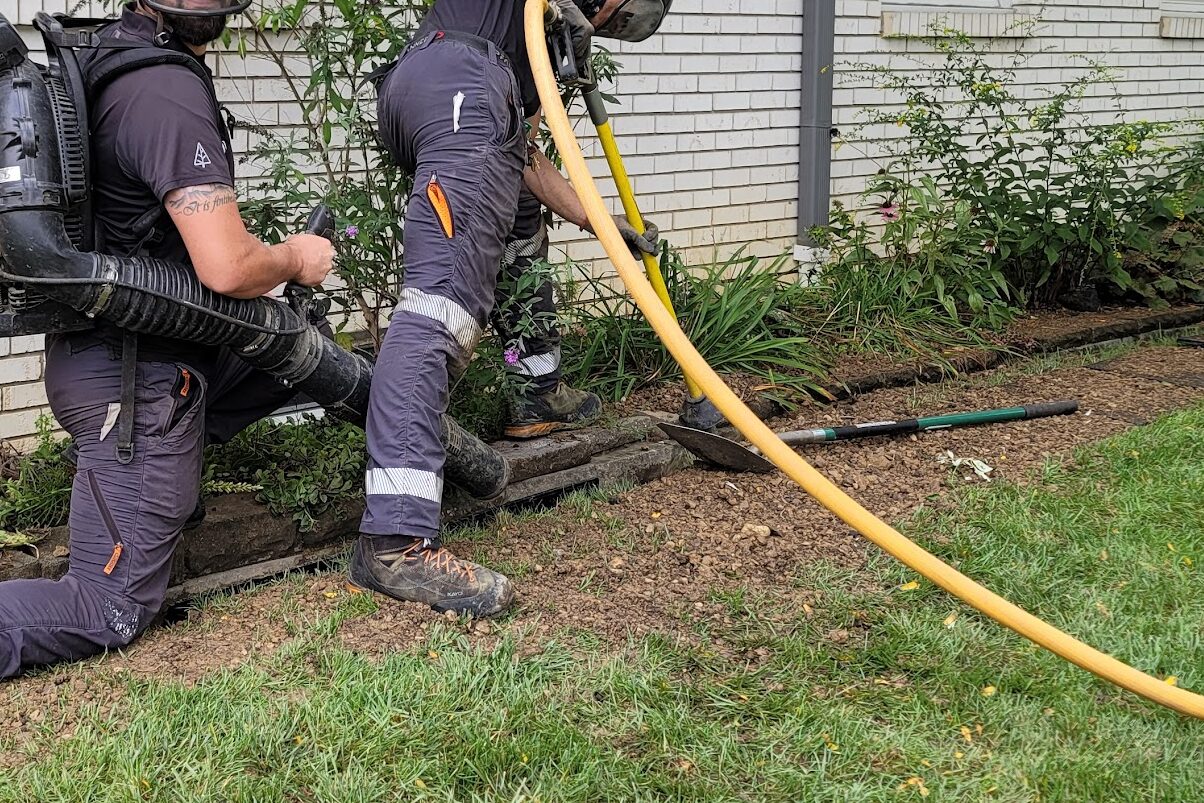
- Trenching: We dig a narrow trench between the tree and your foundation.
- Pruning: We carefully cut the encroaching roots that are heading toward your home.
- Barrier Placement: We install a tough panel system into the trench.
- Redirection: The barrier forces future root growth to redirect deeper into the ground and away from your foundation, protecting your home while allowing the tree to continue thriving.
The Hard Truth: When Mitigation Isn’t an easy Option
We are in the business of protecting your home, but we also have to be honest about the limitations of root mitigation. Proximity is everything.
If a large, mature tree is planted right up against your foundation, installing a root barrier may not be possible. Here is why:
The Structural Root Zone: Trees rely on large, woody roots near their base to keep them anchored upright. If a tree is too close to your house, installing a root barrier requires severing these critical anchor roots.
Cutting a tree’s structural roots creates an immediate, severe hazard. The tree could easily topple over in the next strong windstorm—crashing directly onto the very home you were trying to protect. Furthermore, removing a massive percentage of a tree’s root system all at once will often send the tree into shock, slowly killing it over the next few years.
The Bottom Line: If the tree is simply too close to the foundation, there are no viable mitigation options that will save both the house and the tree. In these extreme cases, tree removal is unfortunately the only responsible way to protect your property’s structural integrity. If tree removal isn’t an option, we recommend reinforcing your basement with I beams and Straps utilizing a local Basement or foundation company. You don’t want to wait until the damage happens or your home can settle and cause other issues.
Don’t Wait Until the Walls Crack
Ignoring a suspicious tree won’t make the roots stop growing. If you are worried about a tree in your yard, the best thing you can do is get a professional assessment before the concrete starts cracking or the doors stop shutting properly.
We can evaluate the species of the tree, the soil type, and the proximity to your home to tell you exactly what your options are—whether that’s a preventative root barrier or a recommendation for removal.
Reach out to our team today to schedule an evaluation and protect your home from the ground down.
James Benedetto
ISA Certified Arborist OH-7011A
Tree Risk Assessment Qualified