

By James Benedetto, ISA Certified Arborist OH-7011A
Drive through almost any Central Ohio neighborhood in spring and you will see mulch volcanoes: cones of fresh, dark mulch piled high against tree trunks. They look tidy, and they are usually built with good intentions. They are also one of the most common tree care mistakes we see.
The practical answer: A mulch volcano is mulch mounded against a tree trunk instead of spread across the root zone. It keeps trunk bark wet, can encourage stem-girdling roots, and hides the root flare where early problems are easiest to spot. The right approach is a wide, flat mulch ring, about 2 to 3 inches deep for typical shredded hardwood, with the mulch pulled back from the trunk and the root flare visible.
What Is a Mulch Volcano?
The root flare, sometimes called the trunk flare, is the point where the trunk widens and transitions into the main roots. On a healthy tree, it should be visible above the soil line. If the trunk disappears straight into the mulch like a telephone pole, the root flare is buried.
Most mulch volcanoes are not built in one day. Each spring, a fresh layer goes on top of the last. Nobody checks the existing depth, the lower layers decompose into material that looks like soil, and the pile slowly creeps higher up the trunk.
Why Do Mulch Volcanoes Damage Trees?
Bark is not root tissue. Trunk bark is built to shed water and dry out. When it stays buried against damp mulch, it can soften, crack, and decay. That gives decay organisms an opening they would not otherwise have.
They can encourage stem-girdling roots. Roots take advantage of the moisture and oxygen in decomposing mulch. As they grow into the mound, they can turn back toward the trunk instead of spreading into the surrounding soil. Over time, those roots thicken, press against the stem, and restrict the tree’s vascular system.
They hide the base of the tree. Some of the most important things we inspect on a mature tree are at the root flare. Buried under mulch, early decay, damaged bark, and girdling roots can go unnoticed until symptoms begin showing in the canopy.
They give rodents cover. Voles and mice chew bark during the winter, and a deep mulch pile gives them protected access to the trunk.
Why Does the Damage Take Years to Appear?
A mulch volcano does not kill a tree quickly. That is exactly why the practice persists. Nothing obvious happens the first summer, so another layer goes on the following spring.
Meanwhile, the problems develop underneath the mulch while the canopy may still look normal. By the time the crown starts thinning or losing color, the root and trunk damage may already be well established.
How Do You Remove Mulch Volcanoes Safely?
Start by pulling the mulch back by hand until you find the root flare. On an older mound, the upper layers may still look like mulch while the lower layers have broken down into something that looks more like soil. Do not assume that the current grade is the original grade.
Go slowly. Buried bark may already be soft, and fine roots may be growing through the mound. A shovel can turn a mulch problem into a root or trunk injury.
Once the flare is exposed, look for roots crossing or wrapping the trunk, compressed bark, cavities, or soft tissue. Some small girdling roots can be removed, but size, position, tree species, and overall condition all matter. Large roots, or roots that have fused against the trunk, should be assessed before anything is cut.
When the buildup is deep or the root collar is congested, we use compressed air to expose the structural roots while minimizing damage. Learn more about our air-spade root care and soil health.
How Should You Mulch Around a Tree?
Mulch is good for trees when it is applied correctly. It moderates soil temperature, holds moisture, reduces competition from turf, and protects the trunk from mowers and string trimmers.
For typical shredded hardwood mulch, keep the total depth around 2 to 3 inches. Check what is already there before adding more. Most trees do not need another full layer every spring. If the existing mulch still has enough depth, rake it lightly instead of burying it under another load.
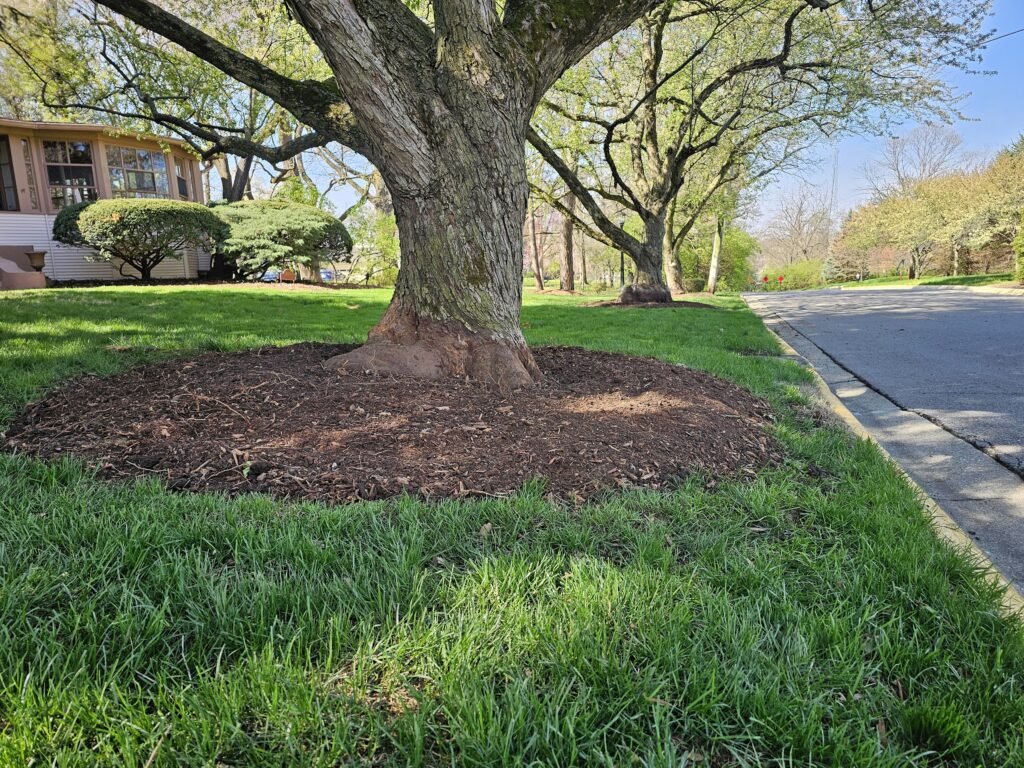
Pull the mulch back 3 to 6 inches from the trunk so the root flare stays visible and dry. Spread the ring as wide as practical, ideally toward the drip line or beyond. A broad, flat ring protects more of the root zone without burying the trunk.
Wide and flat. Not tall and cone-shaped.
Ohio State University Extension has a useful explanation of why mulch volcanoes damage trees and how to mulch correctly.
When Should an Arborist Inspect It?
Not every mulch volcano requires professional excavation. A shallow, recent buildup with intact bark may need only correction and monitoring. A long-standing pile with damaged bark, a deeply buried root flare, established girdling roots, or canopy decline deserves a closer look.
If years of mulch have built up around a tree in Columbus or Central Ohio, request a consultation. We can expose enough of the base to see what is happening and recommend the least invasive correction that makes sense.